

GHR’s Heatprint™ measures how much projects and portfolios slow near-term warming, so organizations can prioritize the reductions that deliver the most per dollar.
WASHINGTON, D.C., July 8, 2026 — Global Heat Reduction (GHR) has been named a winner of the 2026 Keeling Curve Prize. The prize, which carries a $50,000 cash award, is given each year by the non-profit Climate Curve to honor innovative, high-impact climate solutions worldwide. GHR was selected as one of two winners in the Finance category — and one of 10 winners overall — during a ceremony on July 1 emceed by Seth Meyers at the Paul JAS Center in Aspen, Colorado.
“A carbon footprint tells you tonnes. A Heatprint tells you warming — and warming is what we’re all actually trying to stop,” said Kiff Gallagher, Founder and CEO of Global Heat Reduction. “We’re grateful to Climate Curve for backing a better way to measure it, at a moment when the Paris targets are slipping out of reach.”
“GHR is advancing a new way to measure climate impact, one that better tracks super pollutants and helps prioritize the most effective solutions for faster climate, community, and ecosystem benefits,” said Jacquelyn Francis, Founder and Executive Director of Climate Curve.
The Keeling Curve Prize’s Finance category recognizes projects “making the economics and/or financial mechanisms work for heat-trapping gas reduction.” Most financial tools still can’t see which reductions actually slow warming, or how fast. GHR’s Heatprint closes that gap.
The Heatprint, generated through GHR’s Total Climate Accounting™ framework, translates complex climate science into actionable insights that guide investment and policy decisions, steering capital toward faster, higher-impact climate outcomes. Total Climate Accounting complements conventional carbon footprinting by capturing a broader range of climate drivers, including super pollutants like methane and black carbon that are typically undervalued or ignored. The result is clearer visibility into which actions reduce warming fastest, and which deliver the greatest reduction in warming per dollar invested.
The prize takes its name from the Keeling Curve, the graph first published by scientist Charles David Keeling in 1958 from measurements at Hawaii’s Mauna Loa Observatory, tracking the rise of atmospheric carbon dioxide (CO₂) over time — the curve GHR aims to bend.
About Global Heat Reduction
Global Heat Reduction (GHR) gives companies, investors, and governments a clearer basis for climate decisions: the Heatprint™, a measure of how much an action or portfolio adds to or reduces near-term warming across CO₂, methane, black carbon, and other greenhouse gases and super pollutants. Generated through Total Climate Accounting™, the Heatprint works alongside conventional carbon accounting, adding the warming lens that carbon footprints leave out — helping capital find the actions that slow warming fastest. Learn more at heatreduction.com.
Media Contact
press@heatreduction.com
Global Heat Reduction
###

We’re excited to share that oneshot.earth and Global Heat Reduction (GHR) have reached an agreement to bring GHR’s super pollutant methodologies and Heatprint™ data layer onto the Open Carbon Protocol (OCP).
GHR methodologies coming to OCP
Four GHR methodologies will be available on OCP:
- GHR002 — Methane recovery from anaerobic digestion of manure
- GHR003 — Methane recovery from landfill gas
- GHR004 — Methane emission reduction from enteric fermentation
- GHR005 — Emission reductions from rice cultivation
GHR methodologies combine traditional CO2e accounting with a unique radiative forcing approach that incorporates additional short-lived climate pollutants and their impacts over near-term and long-term timeframes.
These methodologies will be in “pending” status until OCP completes an expert-led peer review. Project developers interested in using them on OCP should get in touch with us at info@oneshot.earth.
Heatprint™ Data Layer integration
GHR’s Heatprint™ translates CO2e emissions reduction outputs into their global heat reduction outcomes. With this insight, super pollutant mitigation projects can demonstrate their full climate value while credit buyers and portfolio builders can prioritize and quantify investments that slow planetary warming between now and 2050.OCP will integrate GHR’s Heatprint calculator, enabling Heatprint data for any project on the OCP. This includes:
- Heat impact metrics (including between now and 2050)
- Standardized radiative forcing and heat units (nW/m2 and terajoules) and heat equivalencies
- Visual outputs embedded directly into project dashboards, credit listings, and retirement certificates
Both parties believe project developers and buyers deserve clearer, more effective ways to demonstrate the near-term climate impact of super pollutant credits.
“Climate markets need more than emissions data. They need insight into which projects reduce warming fastest and deliver the greatest climate ROI. By bringing Heatprint data into OCP’s platform, we’re helping make that impact measurable, comparable, and actionable.” — Kiff Gallagher, Founder & CEO , Global Heat Reduction
“The OCP was created to facilitate impactful climate action today. The GHR methodologies will be a great addition to our growing pool of methodologies. The Heatprint Data Layer is a great asset to demonstrate why super pollutant action is necessary now.” — Thomas Annicq, CEO and co-founder, oneshot.earth
More details on review timelines and Heatprint rollout to follow.
#SuperPollutants #CarbonMarkets #Methane #HFCs #ClimateAction #Heatprint #OpenCarbonProtocol
About oneshot.earth / OCP
The Open Carbon Protocol is a data-first registry created by oneshot.earth to document and incentivize impactful climate actions. Our flexible and collaborative registry allows project developers, experts, and stakeholders in the voluntary carbon market to create new methodologies and projects that evolve with the science and the market, financing planetary-scale carbon reductions and removals, and providing the right information that buyers need to make informed risk assessments. Learn more at ocp.earth
About Global Heat Reduction (GHR)
Global Heat Reduction (GHR) is a climate decision-intelligence company that helps public- and private-sector organizations understand which actions reduce warming fastest. GHR’s Total Climate Accounting™ framework builds on traditional carbon accounting by measuring the full range of climate drivers, including super pollutants such as methane, refrigerants, and black carbon. Its Heatprint™ translates that science into a practical decision signal, helping organizations compare interventions, reduce physical risk, and maximize climate ROI. Learn more at heatreduction.com, reach us: info@heatreduction.com.

The Global Heat Reduction Initiative (GHR) has released Version 2.0 of its Registry Standard, ensuring that Heat Reduction Credits seamlessly align with the integrity and transparency standards guiding the global voluntary carbon market, including Integrity Council for the Voluntary Carbon Market (ICVCM) and International Carbon Reduction and Offset Alliance (ICROA) accreditation requirements. GHR plans to pursue formal accreditation under both programs in 2026.
The first of its kind in the voluntary carbon market, GHR’s framework accounts for all heat drivers including super pollutants like methane and HFCs, and air polluting aerosols like black carbon, and quantifies their climate impacts to accelerate global heat reduction.
Key revisions to the Registry Standard include bolstered social and environmental safeguards and expanded stakeholder engagement requirements. Incorporating these updates ensures Heat Reduction Credits remain interoperable with traditional carbon credits, building long-term market integrity and confidence.
“Version 2.0 underscores GHR’s continued leadership in integrating critical near-term reduction efforts into the world’s leading climate action standards,” said Kiff Gallagher, GHR Executive Director. “Project developers and buyers can have the confidence that Heat Reduction Credits meet the highest standards for scientific rigor and transparency.”
With five methodologies released and more in development, the GHR Standard provides public and private organizations with a credible pathway to quantify, verify, and finance heat reduction initiatives that address the full range of climate forcers across target-aligned timescales.
“The GHR Registry Standard brings an unprecedented level of precision to the climate marketplace,” said Linda Brown, Co-founder and Senior Vice President of SCS Global Services. “Version 2.0 builds on our commitment to uphold environmental and social integrity while translating the latest climate science into actionable, verifiable standards.”
The GHR Registry Standard is grounded in the latest Intergovernmental Panel on Climate Change (IPCC) science and reviewed by experts from the Climate and Clean Air Coalition (CCAC), convened by the United Nations Environment Programme (UNEP). This scientific foundation ensures the framework addresses all heat drivers of climate change including those historically undervalued while delivering climate impact data beyond conventional CO₂e reporting.
The GHR Registry Standard (Version 2.0) is now available here. Organizations can learn more at heatreduction.com/registry.
Media Contact:
About the Global Heat Reduction Initiative
Global Heat Reduction Initiative combines cutting-edge methodology with expert advisory, enabling organizations to understand their total climate footprint, plan comprehensive mitigation strategies, and accelerate heat reduction. With this holistic view, organizations can prioritize interventions with the greatest climate return per dollar spent, unlock faster climate progress, and deliver immediate local benefits. Learn more at www.heatreduction.com.
About SCS Global Services
SCS Global Services is an international leader in third-party environmental and sustainability verification, certification, auditing, and standards development with over 40 years of experience. Its programs span a cross-section of industries, recognizing achievements in climate mitigation, green building, product manufacturing, food and agriculture, forestry, consumer products, and more. Headquartered in Emeryville, California, SCS has representatives and affiliate offices throughout the Americas, Asia/Pacific, Europe, and Africa. Its broad network of auditors are experts in their fields, and the company is a trusted partner to companies, agencies, and advocacy organizations due to its dedication to quality and professionalism. SCS is a California-chartered Benefit Corporation, reflecting its commitment to socially and environmentally responsible business practices. SCS is also a Participant of the United Nations Global Compact and adheres to its principles-based approach to responsible business. For more information, visit www.SCSGlobalServices.com.
Media Outlet
30-Day Public Comment Period Announced

Today, the Global Heat Reduction Initiative (GHR) released a first-of-its-kind methodology that will measure and reward the reduction in climate super pollutants achieved through more sustainable rice cultivation practices. In addition to covering the full range of greenhouse gases including the powerful climate pollutants, methane and nitrous oxide, it also accounts for black carbon emissions associated with burning and equipment operations. The methodology also enables users for the first time to assess the global heat reduction value of reducing these emissions over near-term timeframes, such as between now and 2030 or 2050.
“This methodology uses our Total Climate Accounting™ approach to add breadth and depth to the analysis of sustainable rice production projects and credits derived from them,” said Kiff Gallagher, GHR Executive Director. “This new level of information will bring enhanced value for project proponents in terms of climate impact and claims.”
GHR is now seeking public comments from stakeholders interested in providing inputs on the new “Methodology for Assessing Emission Reductions from Rice Cultivation.”
Rice, a cornerstone of global food security, currently drives 1.3%–1.8% of global greenhouse gas emissions. Rice paddy cultivation accounts for 10-12% of global methane emissions. Methane is far more potent than carbon dioxide in the years immediately after being released (80 times more potent over first 20 years), before eventually breaking down into carbon dioxide, which lasts for centuries. Nitrous oxide, another super pollutant, is associated with the production and application of synthetic fertilizers.
In addition to greenhouse gases, open field burning releases plumes of black carbon that fuel air pollution and global warming, with heat impacts many thousands of times more potent than carbon dioxide while airborne. Over time, as black carbon particles fall back to earth, they can deposit on ice and snow, accelerating warming further. Yet despite its significant impacts on both health and climate, black carbon has thus far been largely omitted from current carbon markets, meaning that its mitigation is not currently incentivized. By quantifying black carbon emissions, the new methodology will enable farmers who demonstrate black carbon reductions to yield more credits compared to an approach that only looks at gases.
“Sustainable rice production, including reduced agricultural burning, is a meaningful opportunity to improve air quality and reduce near-term heat,” said Dr. Katie Kaku, GHR Senior Technical Director, who led the development of the methodology.
The methodology reflects GHR’s commitment to driving credible, high-impact mitigation strategies that address all heat drivers. The methodology was developed in consultation with agronomists, climate scientists, and policymakers across the globe to ensure the highest levels of integrity and accuracy.
GHR now invites rice producers, carbon market actors, scientists, and civil society organizations to review and comment on the methodology during its 30-day public consultation period, which begins August 27. The draft methodology and instructions for submitting comments can be found here.
Media Contact:
media@heatreduction.com
About the Global Heat Reduction Initiative
Global Heat Reduction Initiative combines cutting-edge methodology with expert advisory, enabling organizations to understand their total climate footprint, plan comprehensive mitigation strategies, and accelerate heat reduction. With this holistic view, organizations can prioritize interventions with the greatest climate return per dollar spent, unlock faster climate progress, and deliver immediate local benefits. Learn more at www.heatreduction.com.
About SCS Global Services
SCS Global Services is an international leader in third-party environmental and sustainability verification, certification, auditing, and standards development with over 40 years of experience. Its programs span a cross-section of industries, recognizing achievements in climate mitigation, green building, product manufacturing, food and agriculture, forestry, consumer products, and more. Headquartered in Emeryville, California, SCS has representatives and affiliate offices throughout the Americas, Asia/Pacific, Europe, and Africa. Its broad network of auditors are experts in their fields, and the company is a trusted partner to companies, agencies, and advocacy organizations due to its dedication to quality and professionalism. SCS is a California-chartered Benefit Corporation, reflecting its commitment to socially and environmentally responsible business practices. SCS is also a Participant of the United Nations Global Compact and adheres to its principles-based approach to responsible business. For more information, visit www.SCSGlobalServices.com.
Media Outlet
Global Heat Reduction Initiative Helps Companies Answer This Question

The Global Heat Reduction Initiative (GHR) is bringing advanced climate accounting metrics to the table to help companies and other decision makers identify mitigation strategies that can most rapidly and responsibly reduce excess trapped heat in the atmosphere.
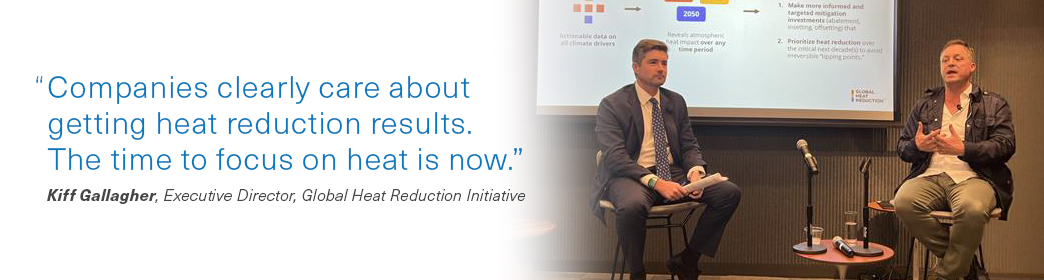
This was the message Executive Director Kiff Gallagher delivered on stage at the “Climate X Data” event organized by the investment firm Immoderata during Climate Week in New York.
“While conventional climate accounting has provided valuable information about greenhouse gas emission levels and emission reductions, there’s a lot more to the story,” said Kiff Gallagher, GHR Executive Director. “Now we can fully value methane mitigation over the crucial next decade, account for very powerful short-lived climate pollutants like black carbon that have been largely left out, consider the effects of changing surface reflectivity, and much more.”
The newly launched initiative unveiled its first set of tools to help private and public sector organizations route their climate dollars where they have the greatest, most immediate impact. It is a groundbreaking, practical application of the latest IPCC-published consensus science aimed at moving the needle on climate stabilization and recovery.
“As the saying goes, you can’t manage what you don’t measure,” said Gallagher. “The comprehensive climate change information built into the peer-reviewed GHR protocols triggers an ‘Aha!’ moment. People immediately sit up straight when you tell them about this.”
The GHR initiative was launched last week by SCS Global Services, a pioneer and international leader in third-party certification and standards setting in the sustainability arena. The initiative currently includes a climate registry, third-party footprint calculation and verification services, and advisory services.
Background
The summer of 2024 was the warmest on record for the Northern hemisphere – again. Nine of the ten hottest years on the books fell in the last decade, and expectations are that 2024 set another record. Climate efforts to date are not meeting the targets identified by the international community.
Non-CO2 climate super pollutants are one of the keys. Roughly half of all current anthropogenic global warming is caused by supercharged heat-trapping pollutants such as methane, black carbon, and HCFs, with methane alone responsible for about 30 percent of all warming since the Industrial Revolution.
Projects that reduce or eliminate these pollutants can often be undertaken with off-the-shelf technologies, with a huge pay-off in terms of short-term heat mitigation – enough to create the necessary bridge to longer term results from reductions of CO2 and other long-lived climate pollutants. And they can simultaneously benefit local communities and ecosystems by improving air and water quality and reducing environmental impacts.
“Companies clearly care about getting heat reduction results – their supply chains, their own operations, and their customers are all being affected,” said Gallagher. “The SEC just said that heat is a financial risk. The time to focus on heat is now.”
To learn more about the GHR, please visit: http://heatreduction.com/documents
About the Global Heat Reduction Initiative
The Global Heat Reduction Initiative (GHR) was launched in 2024 to bring new tools to market that will help slow global warming within the next decade and beyond. The Initiative delivers the most comprehensive climate accounting approach available today, including critical data to unlock financing for projects that can rapidly reduce excess atmospheric heat. GHR services include a climate registry, footprint calculation and verification, and advisory services. GHR is an initiative of SCS Global Services. Learn more at www.heatreduction.com.
About SCS Global Services
SCS Global Services is a global leader in third-party environmental and sustainability verification, certification, auditing, testing, and standards development, currently celebrating its 40th year. Its programs span a cross-section of industries, recognizing achievements in climate mitigation, green building, product manufacturing, food and agriculture, forestry, consumer products, and more. Headquartered in Emeryville, California, SCS has representatives and affiliate offices throughout the Americas, Asia/Pacific, Europe, and Africa. Its broad network of auditors are experts in their fields, and the company is a trusted partner to companies, agencies, and advocacy organizations due to its dedication to quality and professionalism. SCS is a California-chartered Benefit Corporation, reflecting its commitment to socially and environmentally responsible business practices. SCS is also a Participant of the United Nations Global Compact and adheres to its principles-based approach to responsible business. For more information, visit www.SCSGlobalServices.com.
Media Outlet

The Global Heat Reduction (GHR) Registry, a new registry focused on driving climate finance into mitigation projects that support near-term heat reduction, announced the release of three methodologies during Climate Week:
- Methodology for Assessing Emissions Reductions via Collection and Destruction of HFCs
- Methodology for Assessing Methane Recovery from Landfill Gas
- Methodology for Assessing Methane Recovery from Anaerobic Digestion of Manure to Produce Biogas.
Project evaluation conducted under the methodologies will provide a unique window into the heat reduction benefits of mitigating these pollutants over climate-critical timeframes, including 2030, 2040 and 2050, as well as over longer-term time horizons.
Effective immediately, the GHR Registry is ready to begin accepting mitigation projects that will be independently verified against these methodologies. Funded by GHR’s “Heat Reduction Credits” (HRCs), these projects will be able make their mark in near-term heat reduction.
“We are excited to bring these methodologies to market as part of our commitment to slow global warming in the crucial next decade,” said GHR Executive Director, Kiff Gallagher. “Our goal is to stimulate innovative projects that reduce the most potent climate pollutants, and build a bridge to longer term climate stabilization and restoration.”
The GHR Registry is part of a larger Global Heat Reduction Initiative announced last week by SCS Global Services, a pioneer and international leader in third-party certification and standards setting in the sustainability arena.
“The Initiative aims to support companies, governmental agencies, and other organizations in their efforts to gain a more complete understanding of their own climate impacts, and to identify and prioritize efforts that can lead to rapid, sustainable global heat reduction,” said Linda Brown, SCS Co-founder and Senior Vice President.
The GHR Registry takes advantage of groundbreaking climate accounting protocols addressing all drivers of climate change, including many that have been historically overlooked or undervalued, and delivering crucial heat reduction computation over any timeframe of interest.
This accounting approach is a direct application of the most recent consensus science summarized in the Intergovernmental Panel on Climate Change (IPCC) synthesis and special reports of the past decade, especially the fifth and sixth Assessment Reports (AR5 and AR6). It was developed in consultation with international climate experts and peer-reviewed by the Scientific Advisory Panel of the Climate and Clean Air Coalition (CCAC), convened by UNEP.
“Today’s announcements are only the beginning,” said Gallagher. “Several new methodologies are in the pipeline. We are looking forward to welcoming new projects and requests for additional methodologies through registry@heatreduction.com.”
To download copies of the methodologies, or learn more about the GHR Registry, please visit: http://heatreduction.com/documents
About the Global Heat Reduction Initiative
The Global Heat Reduction Initiative (GHR) was launched in 2024 to bring new tools to market that will help slow global warming within the next decade and beyond. The Initiative delivers the most comprehensive climate accounting approach available today, including critical data to unlock financing for projects that canrapidly reduce excess atmospheric heat. GHR services include a climate registry, footprint calculation and verification, and advisory services. GHR is an initiative of SCS Global Services. Learn more at www.heatreduction.com.
About SCS Global Services
SCS Global Services is a global leader in third-party environmental and sustainability verification, certification, auditing, testing, and standards development, currently celebrating its 40th year of services. Its programs span a cross-section of industries, recognizing achievements in climate mitigation, green building, product manufacturing, food and agriculture, forestry, consumer products, and more. Headquartered in Emeryville, California, SCS has representatives and affiliate offices throughout the Americas, Asia/Pacific, Europe, and Africa. Its broad network of auditors are experts in their fields, and the company is a trusted partner to companies, agencies, and advocacy organizations due to its dedication to quality and professionalism. SCS is a California-chartered Benefit Corporation, reflecting its commitment to socially and environmentally responsible business practices. SCS is also a Participant of the United Nations Global Compact and adheres to its principles-based approach to responsible business. For more information, visit www.SCSGlobalServices.com.
Media Outlet

Today, the Global Heat Reduction Initiative (GHR) formally launches two innovative programs to accelerate the fight against climate change. Both aim to measurably draw down excess heat trapped in the atmosphere caused by powerful short-lived climate pollutants (SLCPs) like methane, black carbon, and hydrofluorocarbons, as well as longer-lived emissions like carbon dioxide.
- The Global Heat Reduction Registry will issue high-integrity, third-party verified credits, called Heat Reduction Credits (HRCs), to support effective climate mitigation projects, especially those focused on SLCP reductions, enabling buyers to play a greater role in curbing atmospheric heat rapidly.
- The Global Heat Reduction Climate Footprint provides two paths for organizations seeking to accurately identify and implement solutions that reduce Scope 1, 2 and 3 climate impacts and accelerate heat reduction: 1) verification of organization-level climate footprint; 2) calculation of comprehensive climate footprints for organizations, selected operations and facilities, or specific products and services.
“Current carbon markets and accounting, based on a 100-year impact model, fail to address the crisis of accelerating heat over the critical next two decades,” said GHR’s Executive Director, Kiff Gallagher. “Our new tools complement this long-term model with near-term mitigation data that, for the first time, enable private and public sector entities to prioritize the most potent atmospheric heat drivers on their path to net zero.”
GHR is an initiative of SCS Global Services, a global leader in sustainability standards and certification, including award-winning climate services. GHR’s approach is rooted in decades of company research, project work, and collaboration with internationally renowned scientists. This effort culminated in 2023 with independent peer-review of SCS’ new climate accounting protocol, a direct application of consensus climate science published by the U.N.’s Intergovernmental Panel on Climate Change (IPCC). The peer review was conducted by the Scientific Advisory Panel of the Climate and Clean Air Coalition (CCAC).
“Roughly half of global warming is caused by short-lived climate pollutants,” said Duke University’s Dr. Drew Shindell, a well-known US climate scientist, long-time IPCC contributor, and chair of CCAC’s review panel. “Conventional climate accounting utilizes the global warming potential over 100 years (GWP-100), which provides only a partial window into the accelerating pace of climate change and the respective roles of each climate driver. In particular, it significantly understates the near-term climate potency of short-lived climate pollutants. Because these pollutants dissipate over periods of just a few days to a few years, any effort to curb these pollutants now can have significant benefits in the very near future.”
GHR’s new climate accounting protocol, by contrast, accurately assesses drivers of global warming over any period, not just 100 years. In addition, it includes other factors not incorporated into conventional climate accounting, such as changes in Earth’s reflectivity, and the climate side-effects of cleaning up dangerous air pollutants like sulfur dioxide.
Together, these features set the stage for users to:
- evaluate mitigation options to determine which yield the greatest and most cost-effective climate benefits;
- support vital climate mitigation projects that were previously undervalued or overlooked; and
- make verified claims about their direct contributions to near-term heat reduction
“For 40 years, SCS has converted cutting-edge science into business solutions that protect the planet,” said Matthew Rudolf, President and CEO of SCS Global Services. “GHR is the latest example of our market-based innovation for a sustainable climate and economy.”
“SCS Global Services has long been a pioneer in the climate field,” said Linda Brown, SCS Co-founder and Senior Vice President. “Company founder and CEO, the late Dr. Stanley Rhodes, worked on the science and protocols underlying the Global Heat Reduction Initiative for more than a decade. We are proud to honor his legacy by helping organizations take the next step in the fight against climate change.”
About the Global Heat Reduction Initiative
The Global Heat Reduction Initiative (GHR) was launched in 2024 to bring critical new tools to bear in the battle to slow global warming within the next decade and beyond. Our goal is to help achieve decarbonization by 2050 without triggering irreversible climate tipping point by rapidly reducing excess atmospheric heat now. GHR offers the most comprehensive climate accounting model available today, a climate registry, climate footprint, advocacy, and advisory services. GHR is an initiative of SCS Global Services. Learn more at www.heatreduction.com.
About SCS Global Services
SCS Global Services is a global leader in third-party environmental and sustainability verification, certification, auditing, testing, and standards development, currently celebrating its 40th year of services. Its programs span a cross-section of industries, recognizing achievements in climate mitigation, green building, product manufacturing, food and agriculture, forestry, consumer products, and more. Headquartered in Emeryville, California, SCS has representatives and affiliate offices throughout the Americas, Asia/Pacific, Europe, and Africa. Its broad network of auditors are experts in their fields, and the company is a trusted partner to companies, agencies, and advocacy organizations due to its dedication to quality and professionalism. SCS is a California-chartered Benefit Corporation, reflecting its commitment to socially and environmentally responsible business practices. SCS is also a Participant of the United Nations Global Compact and adheres to its principles-based approach to responsible business. For more information, visit www.SCSGlobalServices.com.
Media Outlet